
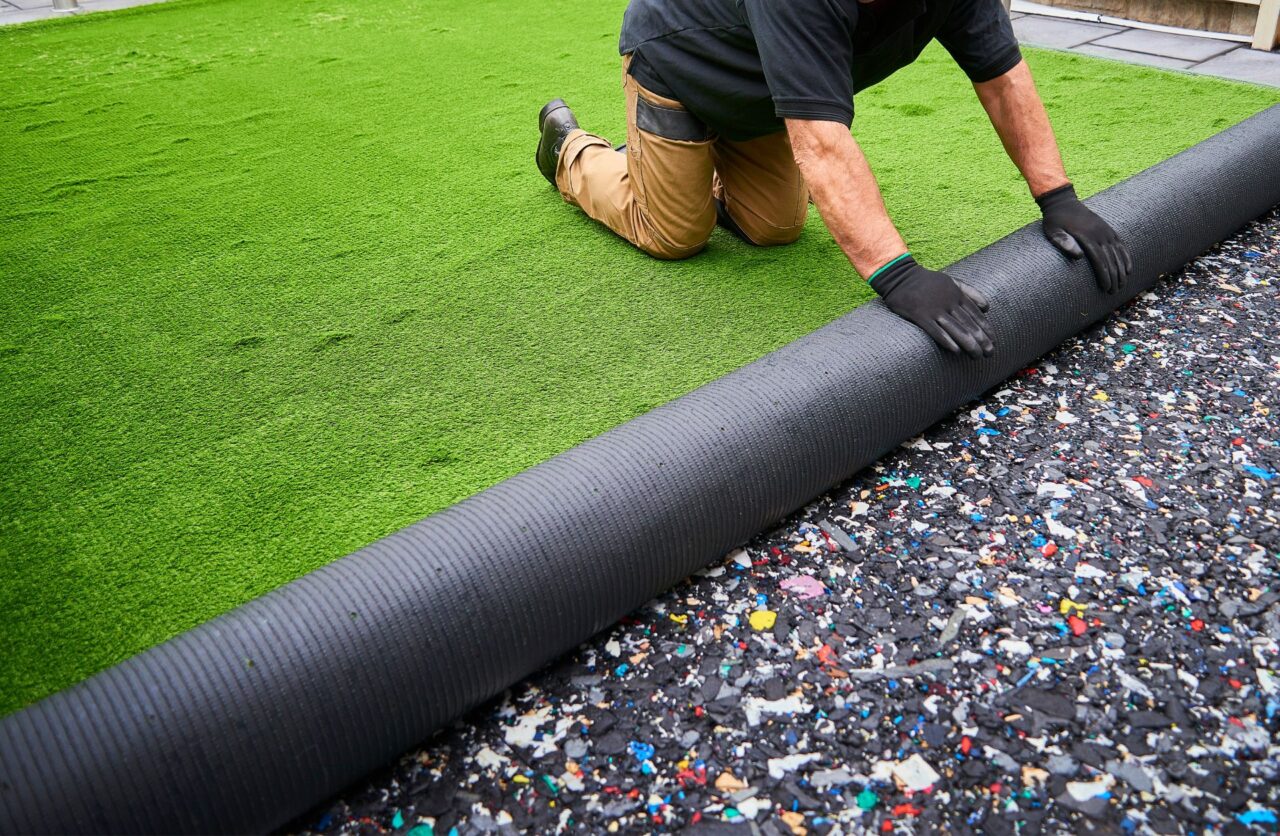
Artificial Grass Drainage and Base Prep for York Region Soil
Drainage and base prep are where an artificial grass installation in York Region succeeds or fails. The turf you see on top is the easy part. What sits underneath, the excavation, the compacted stone and the grading, determines whether your Markham lawn stays firm and dry or turns spongy and uneven after a year of freeze-thaw and heavy rain. York Region clay-heavy soil and cold winters make this groundwork more demanding than in many other places, so it pays to understand what proper base prep involves.
Why does base prep matter so much in York Region?
Because the native soil works against you. Much of Markham and the surrounding York Region sits on the Peel Plain, a physiographic region defined by silty clay and clay-loam soils that drain slowly and hold water. If you lay turf directly over that ground, rain has nowhere to go, and the winter freeze-thaw cycle heaves the surface into bumps and hollows. A properly engineered base replaces the top layer of poor soil with free-draining stone, giving water a fast path down and away while keeping the surface stable through the seasons.
Understanding York Region soil
York Region soil is not uniform, and a good installer reads the lot before quoting. The Peel Plain clay that covers most of Markham percolates poorly, which means water tends to pond rather than soak in. To the north near the Oak Ridges Moraine the ground turns sandier and drains better, but few Markham yards benefit from that. Newer subdivisions in Cornell, Wismer and Greensborough add another wrinkle: builders strip the topsoil and compact the remaining subsoil with heavy equipment, leaving a dense, low-permeability layer that sheds water toward the house. Every one of these conditions calls for a base tuned to the specific lot rather than a one-size spec.
Freeze-thaw and frost heave
Markham winters swing repeatedly above and below freezing, and that freeze-thaw cycling is hard on any surface. When water trapped in poorly drained clay freezes, it expands and lifts the ground, then drops again as it thaws. Over a season this frost heave creates the lumps and dips you see in a badly built lawn or driveway. A deep, well-compacted, free-draining stone base defeats it by holding very little water in the first place, so there is little to freeze and lift. This is the single biggest reason cutting corners on base depth causes trouble later in York Region.
The base layers explained
A correct artificial grass base in Markham is built in stages. First the crew excavates the existing lawn and soil to a suitable depth, typically 100 to 150 millimetres for residential turf and deeper for dog runs or very wet lots. Next they lay and compact a granular stone base, usually a crushed rock blend that locks together while still letting water pass. The surface is graded with a slight, deliberate slope so water moves toward drainage rather than pooling, then compacted again with a plate tamper to a firm, even finish. A weed barrier and, in some cases, a shock or drainage pad go down before the turf itself. Skipping the compaction step is a common shortcut that leads to settling and low spots within the first year.
Drainage systems for wet lots
Some Markham properties need more than a stone base. Low-lying lots near the Rouge River, German Mills Creek or the older parts of Thornhill can have high water tables and poor natural runoff. In those cases an installer may add a French drain, a perforated pipe in a gravel trench, or a channel that carries water to a lower point or a catch basin. Yards that used to flood with real grass usually stay dry once turf is installed over a base with proper drainage built in, because the free-draining stone moves water far faster than compacted clay ever could. If your lot has a known wet corner, the team at Artificial Grass Markham will design the drainage around it during the site visit.
What poor base prep looks like a year later
You can spot a rushed install after one Markham winter. Telltale signs include soft or spongy spots underfoot, visible ripples or waves in the surface, water pooling after rain, and seams that have lifted or separated. These almost always trace back to insufficient excavation, a base that was not compacted, or grading that failed to send water anywhere. The fix usually means pulling the turf and rebuilding the base, which is far more expensive than doing it right the first time. This is why base prep, not the turf brand, is the question to press hardest on when you compare quotes for a backyard installation.
Frequently asked questions
Does artificial grass drain well in clay soil?
Yes, when it is installed over a proper stone base rather than laid on the clay itself. The compacted crushed-stone layer gives water a fast path down and away, which is why a turf lawn often drains better than the natural clay ground it replaced.
How deep should the base be for turf in Markham?
Most residential lawns use a compacted stone base of roughly 100 to 150 millimetres, with more depth for dog runs, heavy-traffic areas or lots with high water tables. The right figure depends on your soil and drainage, which is assessed on site.
Will frost heave damage my artificial lawn?
Not if the base is built to drain. Frost heave is driven by water freezing in the ground, so a free-draining, well-compacted base holds little water and resists lifting through Markham freeze-thaw winters.
Get the groundwork right
A lawn is only as good as the base beneath it. If you want an installation engineered for York Region soil and winters, call (289) 514-5387 or request a free quote and we will assess your drainage before we quote.